13 oct 2016

NASA Develops a Bandage that uses Electricity to Heal Wounds

Researchers at NASA have developed a new substance that generates minute amounts of electricity, for use in a bandage that takes advantage of an electrically-based healing process. This new substance, a polymer called polyvinylidene fluoride (PVDF), produces a mild electrical current when pressure or heat, such as body heat, is applied to it.

“This method utilizes generated low level electrical stimulation to promote the wound healing process while simultaneously protecting it from infection,” according to NASA.

read more


via unknowncountry http://ift.tt/11SbyTl

Un equipo de físicos acaba con la ‘maldición’ de Rayleigh

La resolución de los sistemas ópticos –típicos en telescopios o cámaras fotográficas–, está limitada por el llamado límite de Rayleigh. Un equipo internacional de científicos dirigidos por la Universidad Complutense de Madrid ha conseguido sobrepasarlo, lo que permitirá resoluciones mucho mayores de las actuales y podría obligar a reescribir los libros de Óptica. La investigación supone la culminación de una trepidante carrera entre cuatro grupos de científicos de todo el mundo.
via Matemáticas, Física y Química http://ift.tt/18ZbcUb

Edgar Mitchell and John Podesta Talk ETs & Space Weapons in Leaked Email

 In a recently-released data-dump of emails hacked from Hillary Clinton's email account, Wikileaks included approximately 1,100 emails belonging to her campaign manager, John Podesta. Among them were two recent emails from Apollo 14 astronaut Edgar Mitchell, a long-time advocate of UFO research, discussing a potential meeting between the two regarding the weaponization of space, zero-point energy, and possible extraterrestrial involvement.

"Because the War in Space race is heating up, I felt you should be aware of several factors as you and I schedule our Skype talk."

read more


via unknowncountry http://ift.tt/11SbyTl

12 oct 2016

Deep Into High Strangeness

Wednesday October 12, 2016
We got a taste of her encounters during the childhood roundtable discussion. Now, Darlene, better known as "Cosmic Librarian" at UnknownCountry.com, is here to go deeper into some of her highly strange experiences, their possible meanings, and what they point to in terms of the nature of Visitor phenomena.

To connect with Darlene and share your stories with her, please visit: CosmicLibrarian.com.

via unknowncountry http://ift.tt/11SbyTl

Lost Angels: the Children of the Dark

October 14, 2016
Ron Felber, who thrilled Dreamlanders with his terrific interview on the Mojave Incident in September of 2015 returns with a harrowing and fantastic story to tell us about some of the world's deepest and darkest secrets.

Did you know that half a million children were subjected to creepy personality tests in the 1960s that asked them things like what they thought of their sex organs, and other equally invasive and inappropriate questions?

Where are these children now? More than that WHAT ARE THEY and how might they be endangering us?

read more


via unknowncountry http://ift.tt/11SbyTl

Ya se puede reservar mi nuevo libro: Aviones bizarros

Ha sido un parto de poco más de un año. A lo largo del mes de noviembre estará en librerías, pero ya se puede reservar. Se trata de mi nueva criatura de papel, escrita en esta ocasión junto al piloto e ingeniero aeronáutico José Manuel Gil (que está a los mandos de Sandglass Patrol). Quien conozca el recorrido de #TecOb en su década larga de vida, sabrá que uno de los temas que más he visitado ha sido el de los aviones extraños.

aviones_bizarros

Fruto de la colisión de mundos que supone el aerotrastorno proporcionado por los dos autores de este libro de casi quinientas páginas y más de trescientas imágenes, ha sido esta compilación con los aviones más fascinantes, extraños, raros y arriesgados de toda la historia (en la introducción explicamos por qué utilizamos el término “bizarros”, para quienes se hayan alarmado ante el false friend). En los próximos días iré comentando más detalles del libro. Queda comentar que, quien lo compre en reserva hasta principios de noviembre, recibirá una exclusiva lámina realizada por el pintor aeronáutico Eduardo Alonso. Y, para terminar, cabe mencionar que el prólogo del libro ha sido realizado por el campeón de vuelo acrobático Cástor Fantoba.


Aviones bizarros: Reservar el libro


portada_bizarros

Ya se puede reservar mi nuevo libro: Aviones bizarros apareció originalmente en Tecnología Obsoleta, 12 octubre 2016.


via Tecnología Obsoleta http://ift.tt/16aeRP1

11 oct 2016

Up to One-Third of Native Americans may have Ancient European Roots

A genetic study of the world's oldest anatomically-modern human, the body of a boy buried 24,000 years ago near Siberia's Lake Baikal, has revealed that this individual was of European ancestry. This finding is surprising, in that Lake Baikal, the world's largest freshwater lake, is situated north of modern-day Mongolia, a location quite far east on the Eurasian continent. What is even more surprising is that the DNA of this individual is also found in many Native Americans, half a world away.

read more


via unknowncountry http://ift.tt/11SbyTl

10 oct 2016

Different Types of Meditation Affect Different Parts of the Brain: A Little Something for Everyone

Many of us have been there: we've taken up meditation, followed the practice to the letter, but just couldn't get into the proper state, or didn't achieve any tangible benefits. It is, however, important to remember that each of us are different, with different minds, and thus may need a different practice to follow.

read more


via unknowncountry http://ift.tt/11SbyTl

A Classic Humanoid Drawing


A Classic Humanoid Drawing

This illustration by the late Dr. Fernando Jiménez del Oso (distinguished author and publisher of Espacio y Tiempo and Enigmas) illustrates an article by Iker Jiménez and Lorenzo Fernández appearing in issue No.33 of the latter publication.

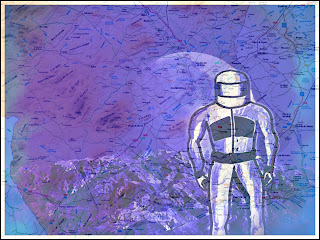
It depicts the August 25, 1979 event in Górliz, Vizcaya, in which two friends - women in their mid-30s - saw a creature suddenly appear out of the surrounding vegetation while they spent the night at a campground. The article places the entity's height at 1.20 meters (4 feet) and describes it as walking hunched over "like a monkey". Witnesses described its skin as dark, and its featureless face was taken up by a pair of eyes "some eight times the size of those on a human" and black hair. As if seeing one frightening figure wasn't enough, the women were treated to the sight of three similar creatures heading toward a hill. A highly luminous object subsequently apepared in on the hill's summit, lighting the area "as though it were daytime."

The last days of this month in 1979 also involved a number of CE-1 cases.

[Translation (c) 2016 S. Corrales IHU with thanks to Ignacio Darnaude and the respective authors]
via Inexplicata-The Journal of Hispanic Ufology http://ift.tt/GCRz8J

El extracto de rúcula y canónigos combate el cáncer de colon en ensayos ‘in vitro’

Investigadores de la Universidad de Almería han comprobado que cuando se añaden extractos de rúcula y canónigos a cultivos de células de cáncer de colon se produce un daño e inhibición del crecimiento en sus membranas celulares, un efecto que no ocurre en cultivos de células sanas.
via Matemáticas, Física y Química http://ift.tt/18ZbcUb

Ensayos in vitro sugieren que la rúcula y los canónigos ayudan a prevenir el cáncer de colon

Investigadores de la Universidad de Almería han comprobado que cuando se añaden extractos de rúcula y canónigos, plantas utilizadas en ensaladas, a cultivos de células de cáncer de colón se logra dañar e inhibir el crecimiento de sus membranas celulares, un efecto que no ocurre en cultivos de células sanas. Los resultados del estudio indican que estos dos vegetales contienen compuestos bioactivos efectivos para prevenir este tipo de cáncer.
via Matemáticas, Física y Química http://ift.tt/18ZbcUb

La rúcula y el canónigo ayudan a prevenir el cáncer de colon

Investigadores de la Universidad de Almería han comprobado que cuando se añaden extractos de rúcula y canónigos, plantas utilizadas en ensaladas, a cultivos de células de cáncer de colón se logra dañar e inhibir el crecimiento de sus membranas celulares, un efecto que no ocurre en cultivos de células sanas. Los resultados del estudio indican que estos dos vegetales contienen compuestos bioactivos contra este tipo de cáncer.
via Matemáticas, Física y Química http://ift.tt/18ZbcUb

Marie Marvingt y la primera ambulancia aérea

Una nota de ayer publicada por @JoseM_SGP me hizo recordar cierta exposición de 2014 acerca de esta fascinante mujer y, sobre todo, me hizo pensar que, hace ahora cien años, ella se encontraba volando por los cielos europeos. ¿Qué mejor ocasión que recuperar este artículo que publiqué en 2009 acerca de la fascinante Marie Marvingt?


Hace poco visitó TecOb la chica halcón, Hélène Dutrieu. Hoy le toca el turno a una contemporánea cuyos méritos no desmerecen, ni de lejos, los de la aventurera del aire e inventora citada.

imgCiertamente, la vida de Marie Marvingt fue excepcional en todos sus aspectos. Viajemos en el tiempo para contemplar a una anciana en el día en que cumple ochenta años. Día 20 de febrero de 1955, una viejecita camina con decisión entre aviones, acompañada de pilotos y curiosos en la base aérea francesa de Toul-Rosières. La estampa es poco común, pero lo que sucederá a continuación será mucho más soprendente. La mujer, junto a un piloto de la U.S. Air Force, se acomoda a bordo de un interceptor supersónico con capacidad nuclear McDonnell F-101 Voodoo. Quien piense que se trata de una simple visita, se equivoca. No va a disfrutar de una simulación, ni tan siquiera pasará un rato en la cabina posterior “jugando” con los mandos. El caza hace rugir a plena potencia sus dos turbinas Pratt & Whitney, recorre la pista y despega. En efecto, una octogenaria ocupa, durante todo un vuelo, un puesto en la cabina de un avión de combate de la OTAN. ¿Qué grandes hazañas había logrado Marie para que le fuera concedido tal honor?

Ese mismo año, la anciana aprendió a volar en helicópteros, consiguiendo la correspondiente licencia de piloto que, por supuesto, no quedó olvidada en su cartera, bien se ocupó de emplear el documento activamente durante años hasta que, en 1963 y con 88 años de edad, abandonó este mundo. Desde entonces, en Francia es considerada como heroína nacional, siendo empleado su nombre para bautizar calles y edificios de todo tipo, entre otros honores. Marie Marvingt publicó varios libros, multitud de artículos, participó en películas y logró incontables premios aeronáuticos pero, sobre todo, es recordada por su tenacidad.

Veamos, siendo breves, habrá que recordar a una jovencita francesa, nacida en 1875, que destacó muy pronto por su habilidad deportiva, siendo capaz de destacar mundialmente en deportes acuáticos, carreras de caballos, atletismo, boxeo y artes marciales, además de en tenis, golf, fútbol, deportes de invierno. ¡Alto! ¿para qué continuar? La verdad es que la chica era algo así como una atleta incansable y polivalente, un portento pocas veces igualado. Por lo demás, poco antes de nacer el siglo XX, consiguió una licencia de conducción de automóviles y ya acumulaba tantos trofeos y medallas que apenas si quedaba espacio en una grande y abigarrada estantería para contenerlas. En la primera década de la nueva centuria sintió la llamada de las montañas y, así, se convirtió en la primera mujer en alcanzar muchos de los picos de los Alpes suizos y franceses. Sus hazañas eran glosadas apasionadamente por los periódicos de la época. En esa época era conocida como anfibio rojo, por el color de su bañador. A finales de esa década se convirtió en auténtica reina de los deportes de invierno y, también, en experta y condecorada tiradora, armada con su carabina era imbatible.

Poco a poco las máquinas fueron tomando un lugar especial en su corazón. En 1910 fue campeona mundial de Bobsleigh, mientras también destacaba en ciclismo, aunque en 1908 sufrió una grave decepción al serle prohibido participar en el Tour de Francia, pues únicamente podían participar hombres. Al poco tiempo, en diversas pruebas, pudo demostrar que podía competir contra cualquier hombre y, gracias a esta tenacidad, logró de la Academia de Deportes Francesa, en 1910, la medalla de oro “por todos los deportes”, algo completamente excepcional. Únicamente con pensar en todo esto uno ya se siente cansado, Marie demostraba tener tanta energía como decenas de personas no pueden desplegar en toda una vida y, sin embargo, solo era el principio.

Nuevamente, una máquina, fue capaz de enamorarla. Ya no era un automóvil, o una bicicleta, ni tan siquiera uno de sus queridos trineos. Desde que en 1901 ascendiera en globo por primera vez, no dejó de pilotar aerostatos, pero deseaba ir más allá. En 1909 probó algo que siempre quedaría en su memoria como el momento en que descubrió su mayor pasión: los aviones. Sus vuelos en globo, como el que realizó cruzando en Mar del Norte a bordo del Estrella Fugaz, temerarios y pioneros, poco podían compararse con su deseo de pilotar aviones. Es considerada como la primera mujer en pilotar en solitario un avión monoplano y, a finales de 1910, logró que le fuera concedida la tercera licencia mundial de piloto de avión que era concedida a una mujer. Su pericia tornó legendaria, a lo largo de casi un millar de vuelos fue capaz de aterrizar sin un solo contratiempo, y eso que no se limitó a vuelos de placer, pues participó en espectáculos peligrosos y competiciones arriesgadas, estableciendo diversas marcas mundiales.

Fue la Gran Guerra la que le impulsó a luchar por una idea en la que venía pensando desde 1912: la construcción de ambulancias aéreas. Luchó en la guerra, incluso en trincheras y en varios frentes. En 1915 se convirtió en la primera mujer en convertirse en piloto de combate, bombardeando territorio alemán, siendo condecorada por ello. He ahí el motivo por el cual, además de ser recordada como impulsora del uso de la aviación en labores sanitarias, se le otorgara el honor de volar a bordo de un caza supersónico al alcanzar la edad de ochenta años.

img
Marie Marvingt, en un dibujo de 1914 obra de Émile Friant sobre la idea de la ambulancia aérea.

Terminada la Primera Guerra Mundial, Marie Marvingt trabajó como periodista, corresponsal de guerra y oficial médico en el norte de África, además de inventar, estando en Marruecos, un sistema de patines metálicos con los que facilitar aterrizajes de aviones sobre arena. Desde entonces, nunca se cansó de promocionar el uso de la aviación para fines médicos y sanitarios, siendo ipulsora de diversas organizaciones relacionadas con el diseño y uso de ambulancias aéreas, logrando en 1935 la primera licencia mundial como piloto paramédico. Y así, llegando a ser nombrada miembro de la Legión de Honor Francesa, cayó otro desastre para Europa. No por ello su energía había disminuido y, en medio de la Segunda Guerra Mundial, trabajó en un hospital para aviadores heridos e inventó un nuevo tipo de sutura quirúrgica. Sinceramente, me descubro ante ella, no creo que el tiempo de una vida pueda llenarse más, con tantas y tan buenas experiencias, inventiva y pasión.


Recorte procedente del número 753 de la revista Alrededor del Mundo, publicado el 2 de noviembre de 1913, cuya lectura recomiendo vivamente. [AMPLIAR RECORTE].

img

Documental sobre Marie Marvingt (Fragmento).

Marie Marvingt la fiancée du danger

Marie Marvingt y la primera ambulancia aérea apareció originalmente en Tecnología Obsoleta, 9 octubre 2016.


via Tecnología Obsoleta http://ift.tt/16aeRP1

9 oct 2016

Spain: A Giant Humanoid in Sangonera, Murcia (1979)


Spain: A Giant Humanoid in Sangonera (Murcia)
By Luis Jimenez Marhuenda
Contactos Extraterrestres, Vol. 2 No.7 (1979)

[The late Luis Jiménez Marhuenda was a distinguished radio personality, having begun his career in broadcasting in Equatorial Guinea (Africa). He went on to become a beloved figure in Spain's UFO and paranormal circles, and INEXPLICATA is pleased and honored to share one of his articles with our readers - SC]

"Look! Can you see that light? How weird!"
"Probably a car"
"A car on a mountaintop? With that kind of headlight?"
"Hail it with the motorcycle headlight!"


And so it was, half seriously, half in jest, that Antonio Guirao and his cousin Jose Carrillo, along with their friends Ginés and Jesús, held a sort of dialogue by means of luminous signals with a strange luminous object that had landed on the top of a summit in Sierra de Carrasco in the vicinity of Sangonera la Verde.
The boys had gone out that night to hunt for turtledove nests on two motorcycles. They stopped at Fuente del Perro at around midnight when at the top of a small hill (known as "el Cabezo Colorao") the sighted the strange luminous object.

Antonio pointed his motorcycle's headlight toward the summit and lit it up. Immediately, a powerful beam of light responded. Thus began an exchange of beams of light that lasted some three quarters of an hour.

The Game Ends in Panic

Antonio is 16. His cousin José is 14. To both of them, it was just a fun and exciting game. Their companions, Ginés and Jesús, also played a gleeful part. It was a warm evening in early July 1979 - an excellent night for an adventure - and that exchange of luminous signals was something uncanny for the boys, who were only vaguely aware of what the UFO phenomenon meant. But the adventure had only just started.

Excited by the strange luminous object, "about the size of a car", as they described it later, located at the summit of a wooded hill, and exchanging lights with it, made them forget everything else. Until the sound of crackling brush nearby alerted them to the presence of an intruder. They scanned the darkness for a few moments until the saw the outline of a tall figure standing over two and a half meters tall, clearly visible in the moonlight. Some dogs that accompanied them started barking in fear.

Frightened, the boys got onto their motorbikes and fled the scene. Their panic was such that when one of the motorcycles experienced a blowout, the passenger had to mount the other bike, which strained toward the town. The rider of the damaged bike chose to remain with his vehicle, well aware that he was damaging it further with every kilometer. With his tire shredded, he arrived in the town, and the time was around one o'clock in the morning.

Several local residents, seeing the boys' agitated state, decided to head out to the location in a couple of cars. Others chose to remain behind. One of them, Fernando Martinez, stated: "I decided to stay here. As soon as the cars departed, those of us who were present were able to see how that thing took off over the hill and after making a turn, shot off in the direction of Cartagena."

The cars and their occupants returned in disappointment. They hadn't been able to see a thing. However, there was now a series of witnesses who could attest to an extraordinary event. As of that moment, the matter became the province of researchers.

A True UFO Nest

Messrs. Jesús Sancho, Antonio Abaladejo and Dr. Martinez Brey traveled from Murcia to Sangonera to study the case "in situ" and speak to the witnesses. There is an extensive report on their visits to the site which we summarize below:

"The possible landing, with the physical presence of occupants, took place in the farm known as Torre Guil within the municipal boundaries of Sangonera. Mr. Pedro Uriza was kind enough to make a Land Rover available to us, driven by Felix, the company driver, who was also a witness to the boys' state of excitement and the damage experienced by the motorbike. We were thus able to reach the location. Mr. Prudencio Jimenez, a shepherd, lives in the vicinity. He too was a witness, years before, of another UFO sighting, precisely in the same area where the events played out.


"Expanding on this strange repetition of the events, I had the chance to speak to a worker at the farm, whose name I do not know. He formally assured me that in the wake of the event involving the youngsters, he has been able to see, in the company of fellow workers and always between 11:00 pm and midnight, how mysterious and powerful lights emerged from that location. After sudden maneuvers, and nearly directly above the witnesses, these objects proceeded to vanish abruptly without traces. In all cases, dogs displayed signs of nervousness and excitement."

Humanoid and Mechanical Prints Are Found

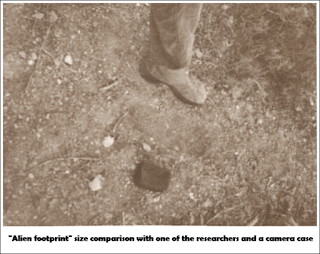
"Some strange prints can be found at the sighting location. The first were found on the access road to the hilltop. It was a print in the shape of a very large foot, with striated markings. The print had a length of 38 centimeters, equivalent to a commercially available shoe in the largest size manufactured, size 47 (13.5 in US measurements). Given the hardness of the soil, a print of this sort cannot be made with a view toward fakery. A meticulous outline, nearly worthy of a sculptor, would be required, using T-squares and triangles to mark the striations. Calculations made by a physics professor in at the Murcia high school estimates that in order to leave a print in this kind of soil, a weight of around 200 kilograms (440 lbs.) would be required.

"Shortly after, once we found ourselves at the place where the UFO was seen, another kind of ground impression was apparent: circular marks some 30 centimeters in diameter. Three of these were found, not equidistant between each other. We attribute these to the "pads" of the UFO. Given the landscape's irregular nature, it is clear that the prints could not be equidistant, since the point of support had to take into account a center of gravity. As an added detail, we must stress that these circular marks had a sort of central cleft measuring some 10 cm. long, suggesting an anti-skid mechanism. Subsequent analysis yielded no results about the provenance of these marks.


"As an added detail, we must make note once more of the panic displayed by the dogs belonging to the shepherd, Prudencio Jimenez. When the vehicles reached his house with the goal of confirming the boys' experience, the witnesses agreed that the animals, of a quite hostile disposition, were cowering under the cars in fear. It also emerged in subsequent interviews that Antonio, one of the youngsters, was able to see the enormous figure clearly. He was scared, but asked his cousin José to wait a little to see "what this guy has to say." But José did not have the slightest inclination to do so, and insisted that the leave at full speed."

The Researchers' Mindset

This concludes the report by the researchers. An extensive dialogue with them does nothing other than confirm a symptom that deserves study in of itself: the mindset of the researchers. Faced with a case that has plausible signs of being genuine, three separate objective stances can be seen to emerge, although all of them agree on the essential points: credibility of the witnesses, ascertainment of facts and the presence of ground imprints at the location.

Jesus Sancho, an old radio man, today a representative for a major liquor firm in the Murcia are, is an expert civil pilot and has a broad knowledge of the UFO subject. To him, the evidence found constitutes total proof. He speaks to the witnesses and draws out their human dimension. This is what he finds most convincing.

Antonio Abaladejo, an attorney, observes, studies and weighs possibilities as if trying to remain on the needle of the scale...the scales of the law which he deals with on a daily basis.

Doctor Martinez Rey considers that the diagnosis requires study. He agrees with his colleagues on the honesty of the witnesses and that "something indeed happened" there, but reserves his opinion with regard to the ground marks.

I know for a fact that these are three highly intelligent and absolutely honest people in their research, but as occurs with any researcher of the UFO phenomenon, they are unable to be absolutely objective about a case to the point of abstracting themselves from their own professional subjective outlook. This must be mentioned when dealing with the UFO phenomenon and must serve as a counterpoint when trying to engage in a general study of the entire phenomenon. It is evident that the UFO phenomenon will always have a subjective feature that it will never shake off. Each case studied shall be made publicly known not only as a function of the witnesses, but of its researchers as well, whose own focus is an inseparable feature.

A Credible Account

The Sangonera case has the kind of witnesses that I find fully credible: simple, humble country folk. They described the UFO as being shaped like "chapina" (seashell). It did not occur to them to liken it to a "flying saucer" or disk shaped objects. This is something new and unknown to them. The excitement of the moment could lead them to exaggerate, but never to lie, and much less to fantasize.

When a young man of humble origin, already working as a lemon harvester at the tender age of 16, allows his motorbike - his most treasured belonging - to be damaged by refusing to stop and fix a flat, leads us to consider the level of fright he must have experienced. The description of the strange being could have hardly emerged from a flight of fancy by the young men:

"It was wearing a sort of plastic raincoat, with a zipper and buttons, stripes on the chest. It was black or dark. And a sort of facemask or helmet on its head."

The extraterrestrial taxonomy is highly varied, and the prototype described by Antonio Guirao fits into some known cases. As to the repetition of cases in the same spot, we know that UFOs are repeaters. They are looking for something. There are iron mines in the vicinity of Sangonera, and they can also be found in Gallarta, where J.J. Benitez found a considerable number of prints in a slag pit. None of this is conclusive, of course. They have also been seen entering and leaving the sea.

Frustrated Communications

This case has left me with an odd impression. When the youngsters were frightened at the sight of a giant being in the darkness, it seems that they all took off running, jumped on their motorbikes and took off. But there's a significant aspect that I cannot overlook. Antonio Guirao says that he called to his cousin to ask him to wait, "to see what this guy has to say." This "guy" was the alleged alien. Was the boy boasting about not having felt the same level of fear as his cohorts? The way he said it does not suggest it. It sounds more like the creature seemed to be friendly, as the young man would confirm later on.

We cannot forget that prior to seeing the creature, the boys had been signaling the UFO, which answered in turn. What would have happened if Antonio had stayed behind? Can we not think that perhaps someone, a fellow Earthman, would have had sufficient presence of mind to hold back to see what the putative alien had to say? And if this is the case, what was dialogue between them?

It could be argued that such a case would end in abduction. But I do not think so. There is always a sort of paralysis in abductions, a mental blockage or submission to the will of the alien, a circumstance that did not arise here. If Antonio had stayed behind, he would have done so at his own will, out of sheer curiosity.

It is possible that someone has made it to this point. If so, it is likely that they may never want to discuss it. For this reason we remain bewildered, wondering what it is "they" are thinking.

Perhaps Antonio Guirao, the 16-year-old farmhand was on the verge of finding out. What can we think about these circumstances? To answer this question, I shall avail myself of the words of Jesus Sancho in his report: "The UFO allowed itself to be seen, and even signaled back, responding to the luminous signals made by the boys. Since they weren't going away - the moon was very bright - a ufonaut departed the craft to visit the kids. But this was too much for their nerves."

[Translation (c) 2016 Scott Corrales, Institute of Hispanic Ufology]


via Inexplicata-The Journal of Hispanic Ufology http://ift.tt/GCRz8J